In case you were wondering where I've been for six months... I'm still here! Trying to keep my head above water, but life is good if very full.
Thanks to Mike, Donna, and Alwen for your comments on my last post. Sorry I've been so tardy in responding. I really enjoy hearing from others with similar interests and passions, especially those who happen to be authors of poems I post...!
I encourage all of you to check out First Freedom First if you have an interest in preserving religious liberty in the U.S.
In this Lenten season, I also invite reflection on how your daily choices are connected to the well-being of others around the world and to the earth itself, from the labor rights of textile workers in China to the pesticides used for non-organic farming in Iowa (and every other state). To learn more about how you can be involved in change, visit Bread for the World, which sponsors an "Offering of Letters" to political leaders each year. This year's theme, Seeds of Change, addresses the need for a farm bill that takes strategic steps to reduce hunger and poverty in this country and in developing countries. Bread for the World sees personal involvement in legislative advocacy as "a sacred act of citizenship" when you communicate how your beliefs and values relate to the issues facing our leaders and communities today.
I can't promise I'm back to posting regularly, but I'll try not to let six months go by in silence again!
Blessings to you all.
Friday, March 09, 2007

Friday, September 22, 2006
Yeast Thoughts
My camera has been stolen. :( No more photos for a while.
I was reading through some resources for World Communion Sunday at the General Board of Discipleship (UMC), and came across this reflection that I want to share with you.
I was reading through some resources for World Communion Sunday at the General Board of Discipleship (UMC), and came across this reflection that I want to share with you.
by Mike Hodge
Yeast makes bread rise because of the bubbles of gas that it produces. When the yeast is mixed throughout the dough, the bread rises and has the proper rough and airy texture. But if all of the yeast is lumped together in one small part of the dough, the bread won't rise evenly and will have big, empty holes in it. Even so, the church — the people of the Kingdom — must be intimately involved in life, in the world, in the flour of humanity. When we have clustered ourselves together, fearfully barricaded behind sanctuary walls, we have created great, empty holes in God's world that are filled with nothing but hot air. But if we who call ourselves yeast are willing to become so involved in the pain, the despair, and the laughter of life that our main concern becomes enabling people to grow into all that they can be — then God's bread will become perfect in quality, with yeast permeating every part of the dough. Being involved with life — intimately mixed through and through it — sounds dangerous. Yeast dies in the oven, having lost itself to the creation of something new. May we also be willing to lose ourselves.
This reading is from Alive Now!, September-October 1976, copyright © 1976 by The Upper Room. Attempts in contacting the author have been unsuccessful and we solicit any information on their whereabouts. At the time of publication these writers were students at Scarritt-Bennett College in Nashville, Tennessee.
Saturday, August 19, 2006
Korea pics
Yes, I'm a complete delinquent here. But sometimes life in the real world takes precedence.
Here are a couple photos from Korea for anyone still tuned in. I leave tomorrow to spend a week leading orientation (in Cheyenne) for our four new volunteers. I'm pretty sure it's not going to be a complete disaster... beyond that, I don't want to jinx it! We do have a house, and a bunch of furniture, and I have a schedule and packets of materials for orientation, and we're going on retreat Thursday to Saturday, so really, I'm hoping anything else I forgot can be taken care of after this week.
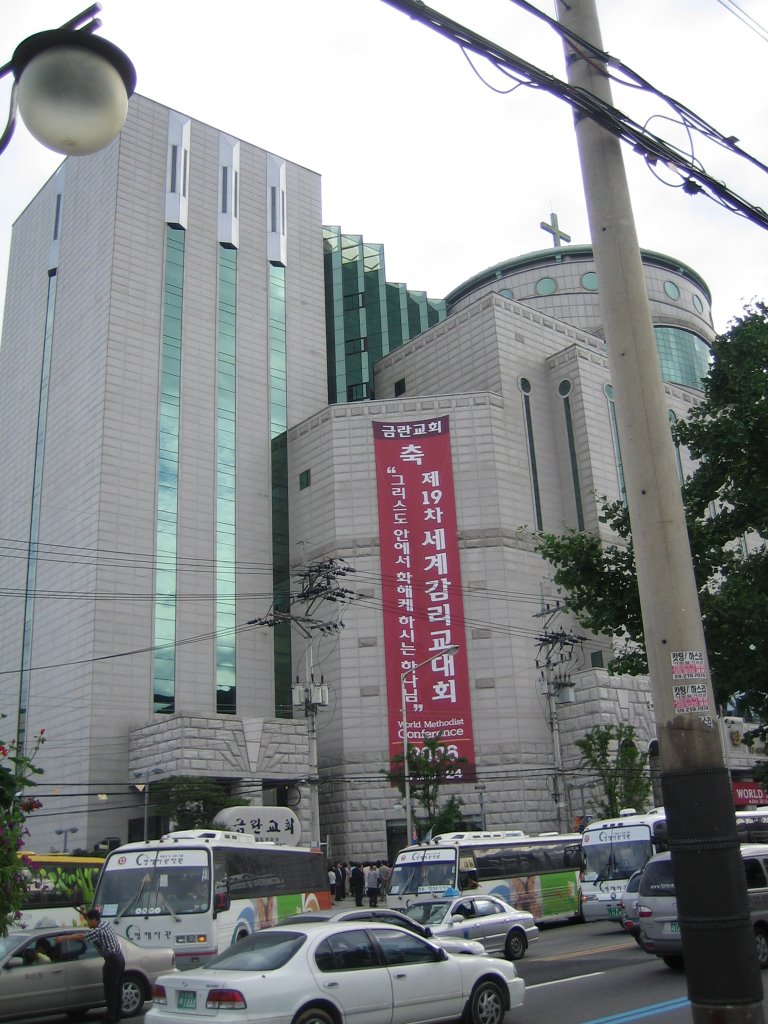
 The first two photos are Kumnan Methodist Church in Seoul, where the 19th World Methodist Conference was held. This church has 110,000 members. Seriously.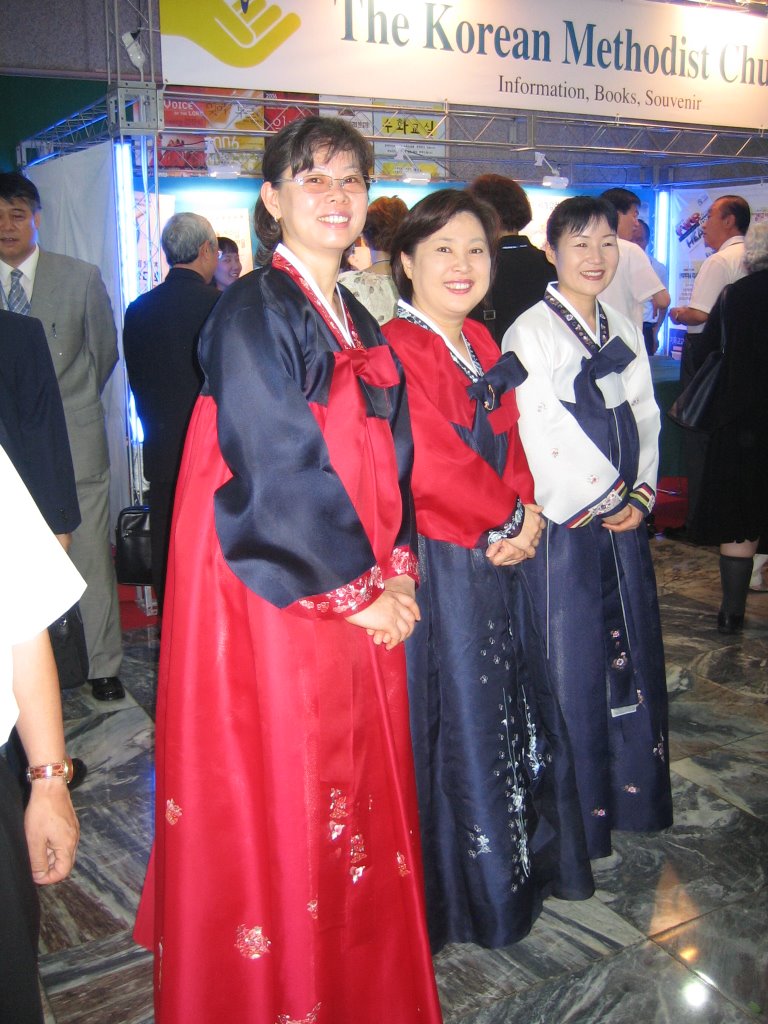
Every morning when we entered, we were greeted warmly by women in traditional dress. There were also people in every stairwell, smiling and bowing as we passed. Kumnan Methodist Church provided morning and afternoon refreshments, plus lunch, every day for over 2000 people attending the conference. Now that's what I call hospitality.
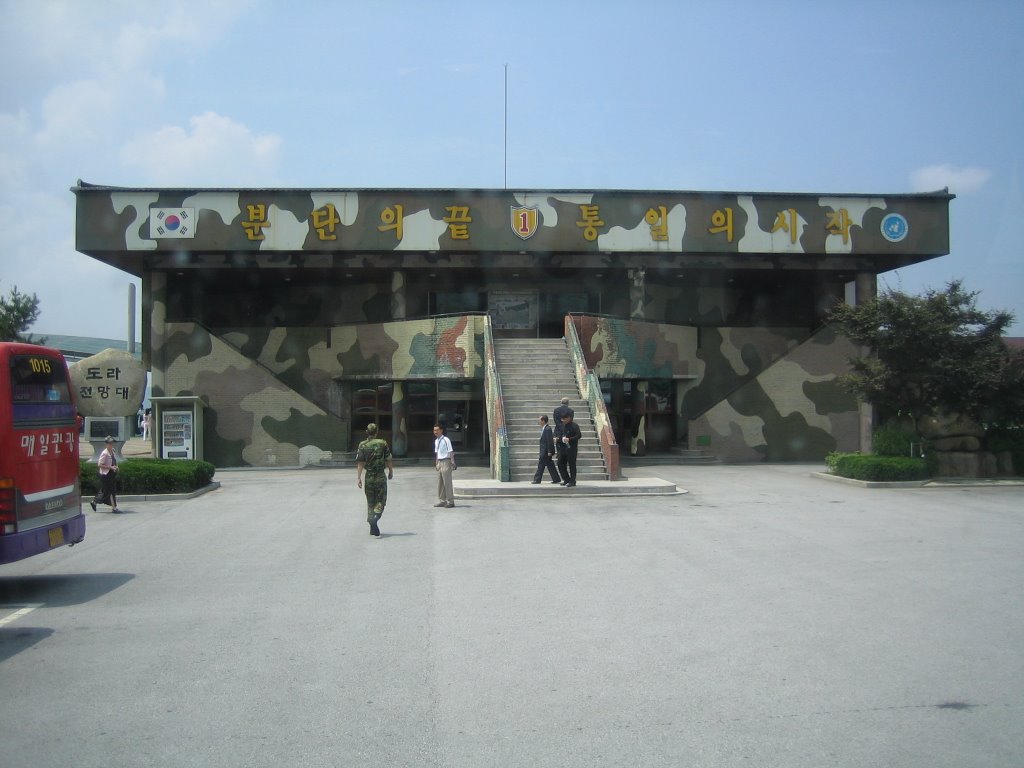 One of the highlights of the trip for me was visiting a guard post at the edge of the De-Militarized Zone (DMZ) with North Korea. I don't think I can do the experience justice in this space, but ask me sometime and I'll be glad to tell you about it.
We had to stand behind a yellow line 20 feet back from the wall of the viewing area to take
 pictures. The DMZ itself is 4 km across, 2 km each side of the Line of Demarcation. There are two small villages within the DMZ, one of which is a ghost town put up for show as part of the peace agreement, plus an industrial zone where a small number of North Koreans and South Koreans are now permitted to work side by side. The valley is lush and green, except for a barren dirt area around the industrial zone. You can just make out the mountains of North Korea, which we learned are stripped completely bare of trees because of the people's poverty there.
Someone from our group started to sing "Let There Be Peace on Earth," and gradually several others joined in. Two soldiers hurried over and told us, “No singing, no singing!” “No religious services are allowed here.” “Stop singing, please!”
Truly, a simple prayer sung from the heart is a powerful thing - it even makes soldiers nervous.
Don't tell me hate is ever right or God's will
These are the wheels we put in motion ourselves
The whole world weeps and is weeping still
Though shaken I still believe
the best of what we all can be
The only peace this world will know
can only come from love.
-- Carrie Newcomer, "I Heard an Owl," from Gathering of Spirits
These are balloons we released with prayers for peace and reconciliation during an outdoor worship service a few miles south of the DMZ.


On the left is Fabiola Grandon from Chile, a new member of the officers of the World Methodist Council, and a new friend of mine.
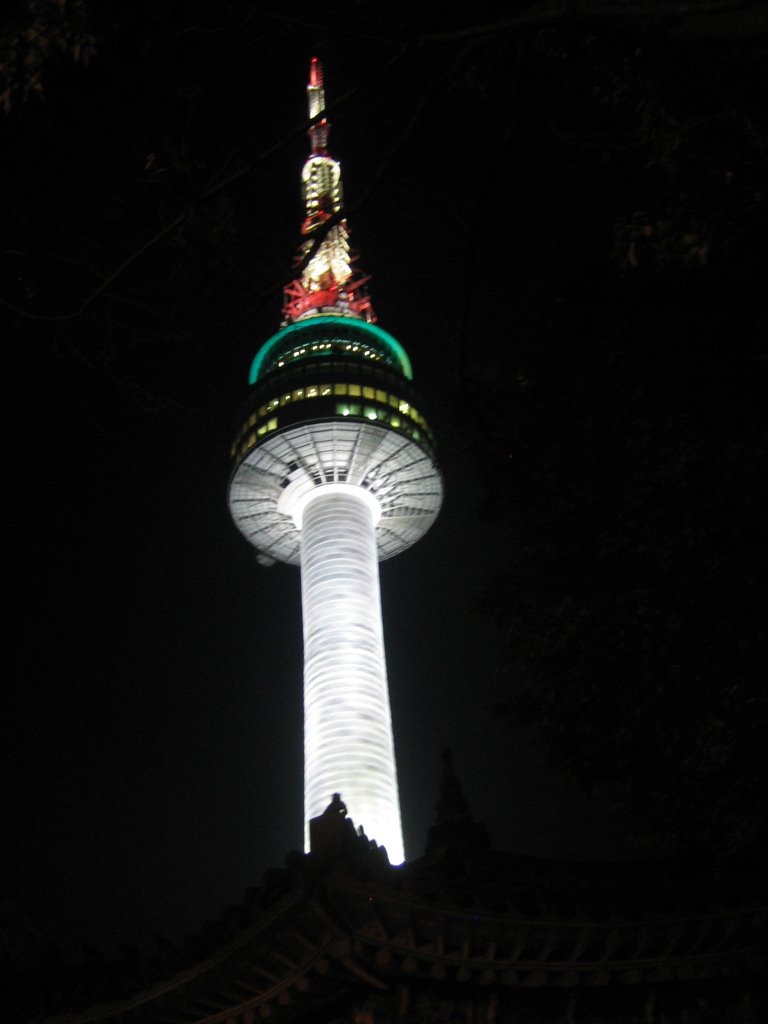
Finally, I did manage to do a little sightseeing while in Korea: N Seoul Tower (yes, we went up in it to the observation area) and Deoksugung Palace, first built in the 15th century.

I have more pictures, but not enough time to post them today. Hope you enjoy these!
Wednesday, July 19, 2006
Lots of Methodists in Korea
Greetings, fellow bloggers! I write this post from Seoul, (South) Korea, where the World Methodist Council has just wrapped up business after two days of meetings. Tomorrow begins the World Methodist Conference, a celebration of some 73 churches/denominations with roots in the Methodist tradition, with ministries in 132 countries around the world. Very exciting to be here as a Council member, and I hope to have a chance to see some of the city before I leave next week. But I might not have much chance to post again while here. Hope you're all well out there!
Friday, July 07, 2006
Why I am not a patriot
In this week of the Fourth of July, Independence Day here in the U.S., I've been thinking a lot about patriotism and nationalism, allegiance and obligation, freedom and justice.
As someone with dual citizenship (U.S. and Australia), I have never been able to get fully on board with the flag-waving, red-white-and-blue-wearing, if-you're-not-with-us-you're-against-us mindset about the country of my birth. I love fireworks - regardless of the occasion - and I enjoy apple pie, but I do not say the pledge of allegiance. My allegiance is with God, as I have known God to be revealed in Jesus the Christ, who stood for compassion and justice, love and response-ability to those in need. I certainly appreciate the gifts of a democratic government, but I do not believe it is ordained by God any more than the monarchies of Europe. And don't get me started on capitalism.
I have recently begun to examine my willingness to sing the American national anthem, "The Star-Spangled Banner." Previously I felt this was more acceptable to my conscience than pledging allegiance, but a musing from Dean McIntyre of the General Board of Discipleship has made me reconsider: "It is not a hymn or sacred song — it is a recounting through music of a military battle." As someone who abhors war and believes that the greatest justice and peace can be accomplished through nonviolent means, I am somewhat astonished that I never reflected on the battle perspective of the anthem before.
In contrast, Australia's national anthem, "Advance Australia Fair," focuses on the courage and optimism of the people and the natural resources of the land (but check out the original lyrics for some rampant imperialism and echoes of "Manifest Destiny"). I guess any time we (Euro-mutt immigrants' descendants) start to wax poetic about the places we've come to reside in, we have trouble remembering that the land is all part of God's creation, and was originally inhabited by others with customs and cultures indigenous to what we think of as "our" part of the world.
My personal preference, for honoring one's native land without forgetting that God is God of the whole world, is "This Is My Song," set to the tune Finlandia. Consider verse 1:
When we remember that all people on earth are God's children, it becomes harder to justify "collateral damage" and civilian casualties - or even, if we are really convicted of God's love for all humanity, to justify the vast sums we spend on building bigger bombs and tanks to destroy other countries' armies.
Many argue that "freedom isn't free," and that we would not have the privileges of freedom and democracy in this country today without the sacrifices that soldiers have made over the years. There is some truth to this, but I think it fails to see the larger picture. My problem is not with people who believe something so strongly they are willing to live and die for it; I have a problem with people who believe so passionately and blindly that they are willing to kill others for the cause.
Jim Winkler, of the UMC General Board of Church and Society, has written a thoughtful article on the relationship between violence and freedom. I greatly appreciate his countercultural perspective that it is possible to win liberty and democracy without a bloody revolutionary war.
So what did I do on the 4th of July this year? Not much. I helped make an apple pie. I watched Good Night, and Good Luck on video. And I prayed that people around the world might know liberty, justice, and peace - and that we might stop seeing violence and war as the solution to every problem we face.
As someone with dual citizenship (U.S. and Australia), I have never been able to get fully on board with the flag-waving, red-white-and-blue-wearing, if-you're-not-with-us-you're-against-us mindset about the country of my birth. I love fireworks - regardless of the occasion - and I enjoy apple pie, but I do not say the pledge of allegiance. My allegiance is with God, as I have known God to be revealed in Jesus the Christ, who stood for compassion and justice, love and response-ability to those in need. I certainly appreciate the gifts of a democratic government, but I do not believe it is ordained by God any more than the monarchies of Europe. And don't get me started on capitalism.
I have recently begun to examine my willingness to sing the American national anthem, "The Star-Spangled Banner." Previously I felt this was more acceptable to my conscience than pledging allegiance, but a musing from Dean McIntyre of the General Board of Discipleship has made me reconsider: "It is not a hymn or sacred song — it is a recounting through music of a military battle." As someone who abhors war and believes that the greatest justice and peace can be accomplished through nonviolent means, I am somewhat astonished that I never reflected on the battle perspective of the anthem before.
In contrast, Australia's national anthem, "Advance Australia Fair," focuses on the courage and optimism of the people and the natural resources of the land (but check out the original lyrics for some rampant imperialism and echoes of "Manifest Destiny"). I guess any time we (Euro-mutt immigrants' descendants) start to wax poetic about the places we've come to reside in, we have trouble remembering that the land is all part of God's creation, and was originally inhabited by others with customs and cultures indigenous to what we think of as "our" part of the world.
My personal preference, for honoring one's native land without forgetting that God is God of the whole world, is "This Is My Song," set to the tune Finlandia. Consider verse 1:
This is my song, O God of all the nations,
A song of peace for lands afar and mine.
This is my home, the country where my heart is
Here are my hopes, my dreams, my sacred shrine.
But other hearts in other lands are beating,
With hopes and dreams as true and high as mine.
When we remember that all people on earth are God's children, it becomes harder to justify "collateral damage" and civilian casualties - or even, if we are really convicted of God's love for all humanity, to justify the vast sums we spend on building bigger bombs and tanks to destroy other countries' armies.
Many argue that "freedom isn't free," and that we would not have the privileges of freedom and democracy in this country today without the sacrifices that soldiers have made over the years. There is some truth to this, but I think it fails to see the larger picture. My problem is not with people who believe something so strongly they are willing to live and die for it; I have a problem with people who believe so passionately and blindly that they are willing to kill others for the cause.
Jim Winkler, of the UMC General Board of Church and Society, has written a thoughtful article on the relationship between violence and freedom. I greatly appreciate his countercultural perspective that it is possible to win liberty and democracy without a bloody revolutionary war.
So what did I do on the 4th of July this year? Not much. I helped make an apple pie. I watched Good Night, and Good Luck on video. And I prayed that people around the world might know liberty, justice, and peace - and that we might stop seeing violence and war as the solution to every problem we face.
Subscribe to:
Posts (Atom)